Buying property in Switzerland as a foreigner: the holiday home guide
Can foreigners buy property in Switzerland? Yes, but the rules are considerably stricter than in many other European countries. Whether you can purchase a chalet or ski apartment depends on your nationality, residency status, the property's location and its legal designation.
Foreign buyers in Switzerland face two sets of rules: Lex Koller, which governs property purchases by foreign buyers, and the Swiss Second Homes Act, which restricts the creation of new holiday homes in many Alpine municipalities.
This guide explains what foreign buyers need to know before purchasing a holiday home in Switzerland. It draws on our work in Alpine property and on the Swiss federal and cantonal sources listed at the end.
1. Can foreigners buy property in Switzerland?
Yes, although Switzerland distinguishes between foreign nationals who live in the country and those who reside abroad.
The rules are governed primarily by the Federal Act on the Acquisition of Immovable Property by Foreign Non-Residents, commonly known as Lex Koller.
EU and EFTA citizens living in Switzerland
EU and EFTA citizens who are legally and genuinely resident in Switzerland generally have the same residential property purchasing rights as Swiss nationals.
They can normally purchase a primary residence or holiday home without Lex Koller authorisation, although planning and second-home restrictions still apply.
Non-EU citizens living in Switzerland
Non-EU citizens holding a Swiss C settlement permit generally enjoy similar purchasing rights.
Those holding a B residence permit may normally purchase a home at their actual Swiss place of residence without special authorisation, subject to applicable conditions. Purchasing a separate holiday home remains more restricted.
Foreign buyers living outside Switzerland
For foreign non-residents, including EU citizens living abroad, the rules are considerably stricter.
A holiday home can generally be purchased only in an eligible tourist municipality, with the required cantonal authorisation and within the applicable quota.
PURE's advice: Before arranging viewings, establish whether your residency status permits you to buy the type of property you are considering.
2. What is Lex Koller?
Lex Koller regulates the acquisition of Swiss residential property by persons considered to be abroad.
It is particularly relevant to international buyers who want a chalet or ski apartment without becoming Swiss residents.
How does Lex Koller affect holiday-home purchases?
Foreign non-residents may purchase qualifying holiday homes only under specific conditions.
These commonly include:
- The property must be in a municipality where such acquisitions are permitted.
- Cantonal authorisation is generally required.
- The purchase must fall within the applicable holiday-home quota.
- Restrictions on property size and land area may apply.
- A buyer and their family are generally limited to one qualifying Swiss holiday home.
- Rental and resale conditions may apply.
Switzerland has a national ceiling of 1,500 holiday-home quota units a year for persons abroad, shared among the participating cantons: Graubünden has 290, Valais 330 and Vaud 175 (Federal Act on the Acquisition of Real Estate by Persons Abroad, BewG Art. 11, and its ordinance, BewV Art. 9 and Annex 1).
As a rule, a holiday home is limited to 200 m² of net living area and, for a house that is not a condominium unit, 1,000 m² of land (BewV Art. 10). If the buyer shows a need for more, cantons usually approve up to about 250 m² and 1,500 m² of land.
In April 2026 the Federal Council proposed tightening Lex Koller, with smaller holiday-home quotas for the cantons and a permit for more purchases by buyers from outside the EU. The consultation closed in July 2026 and parliament has not decided yet, so the current rules still apply (Federal Council).
Can you buy through a Swiss company?
Purchasing through a Swiss company does not automatically avoid Lex Koller.
Companies controlled by persons abroad may themselves be subject to the legislation.
Ownership structures should therefore be reviewed by a Swiss legal specialist before proceeding.
3. Can foreigners buy a chalet in the Swiss Alps?
Yes, but availability depends on the specific resort and property.
Some of Switzerland's best-known ski destinations have properties that may be sold to qualifying foreign non-residents. Others have very limited opportunities or additional restrictions.
Verbier
Verbier is one of Switzerland's most prestigious ski resorts, known for its extensive skiing, international clientele and lively village atmosphere.
Qualifying properties may be available to foreign buyers, subject to Lex Koller and cantonal requirements.
Zermatt
Zermatt is internationally recognised for the Matterhorn, its high-altitude skiing and its traditional car-free village.
The market is highly sought after, but foreign-buyer eligibility must be checked carefully for each property.
Crans-Montana
Crans-Montana combines skiing, golf, sunshine and a strong summer season.
Its broad range of apartments and chalets makes it attractive to buyers seeking year-round Alpine enjoyment.
Villars and Les Diablerets
Located in the canton of Vaud, these resorts offer a traditional Swiss mountain atmosphere and relatively convenient access from Geneva.
Qualifying holiday-home purchases by foreign non-residents may be possible.
St. Moritz, Davos and Klosters
Graubünden includes some of Switzerland's most established luxury destinations.
However, purchasing rules and property availability vary, and foreign non-resident buyers should not assume that every residential property can be acquired.
Samnaun
Samnaun-Compatsch in Graubünden lies in the Silvretta Arena, the ski area it shares with Ischgl in Austria. The village is also a duty-free zone, outside Swiss customs territory.
More than half of Samnaun's homes are second homes (federal housing inventory), so the Second Homes Act (section 4) allows a new holiday apartment here, as a rule, only when it is let to guests through a hotel-style operation. That is how The Edge 1734 works: 22 apartments in four connected buildings, whose rentals are run by a professional hotel operator. The development is open to buyers who live abroad, from the EU or elsewhere. Each needs a permit from the canton under Lex Koller, and we can tell you what that involves for a specific apartment.
PURE's advice: ask how many weeks a year you may use a hotel-managed apartment yourself. The operator's contract and the permit both set limits.
In every resort, check two things: whether you may buy, and how the home may be used.
4. What is Lex Weber and Switzerland's 20% second-home rule?
In addition to Lex Koller, Switzerland has legislation restricting the construction of new second homes.
The Swiss Second Homes Act, often associated with the name Lex Weber, generally prohibits the authorisation of new unrestricted second homes in municipalities where second homes account for more than 20% of the housing stock, subject to statutory exceptions.
This applies to Swiss buyers as well as foreigners.
Existing holiday homes
Existing properties that lawfully qualify as second homes may retain important rights.
However, buyers should confirm whether the property is unrestricted, subject to a primary-residence condition or tied to an approved tourist accommodation arrangement.
New-build apartments
In municipalities above the 20% threshold, new residential developments may be subject to special restrictions.
Some properties must be used as primary residences, while others may qualify under specific tourist accommodation provisions.
Can you buy a Swiss holiday home without renting it out?
Yes, if the home may lawfully be used as an unrestricted second home. That usually means a home that already existed lawfully, or had a final building permit, on 11 March 2012, the day the second-home initiative was approved. In a municipality with more than 20% second homes, a new-build may as a rule be a holiday home only if it is let to guests through a hotel-style operation, which works much like a rental obligation. A home bought under Lex Koller may not be let all year round either.
Ask for written confirmation of the property's status before you buy.
The difference between Lex Koller and Lex Weber
Regulation | What it controls | Main question |
|---|---|---|
Lex Koller | Acquisition by foreign buyers | Are you permitted to purchase? |
Second Homes Act / Lex Weber | Construction and use of second homes | Can the property legally be used as a holiday home? |
A foreign buyer must satisfy both sets of rules where applicable.
5. How to buy property in Switzerland: Step by step
The Swiss purchasing process is well regulated, with notaries and cantonal authorities playing central roles.
Step 1: Confirm your eligibility
Establish whether you are subject to Lex Koller and whether the property can legally be purchased by a foreign non-resident.
Where authorisation is required, obtain advice about the prospects and procedure before making a binding commitment.
Step 2: Find a suitable property
Select a property that meets your requirements in terms of location, size, accessibility, facilities and permitted use.
For Alpine properties, also consider year-round access, ski connections, maintenance costs and rental possibilities.
Step 3: Review the documentation
Important documents include:
- Land Registry extract.
- Building permits.
- Second-home status.
- Condominium regulations.
- Service charge statements.
- Mortgage and other registered charges.
- Any Lex Koller authorisation requirements.
Step 4: Offer and reservation
Buyers may submit an offer or enter into a reservation arrangement.
A Swiss real estate purchase contract generally requires public notarisation to be legally valid. Nevertheless, reservation agreements can have financial consequences and should be reviewed before paying a deposit.
Step 5: Notarial purchase agreement
The formal purchase agreement is prepared and authenticated by the authorised notary or public official.
The agreement should address financing, required approvals, payment arrangements and completion conditions.
Step 6: Registration and handover
Ownership is transferred through registration in the Swiss Land Registry.
The notary coordinates the relevant documentation, payments and registration requirements.
6. How much does it cost to buy property in Switzerland?
Property purchase costs vary significantly between cantons.
Unlike Austria, Switzerland does not apply one nationwide property transfer tax.
Purchase cost | Typical treatment |
|---|---|
Property transfer tax | Depends on canton, see below |
Notary fees | Cantonal tariffs or applicable charges |
Land Registry fees | Varies by canton |
Mortgage security costs | Depends on financing |
Legal and administrative fees | Depends on transaction |
Estate agent commission | Commonly seller-paid, subject to agreement |
A provisional allowance of approximately 2–5% of the purchase price may be useful for initial budgeting, but the actual figure can differ substantially.
The transfer tax in the three cantons with most Alpine resorts:
Canton | Property transfer tax | Who pays |
|---|---|---|
Graubünden (Samnaun, St. Moritz, Davos, Klosters) | No cantonal tax; each commune may charge up to 2% | The buyer, as a rule |
Valais (Verbier, Zermatt, Crans-Montana) | 1.0–1.5% cantonal, rising with the price, plus up to half of that for the commune | The buyer |
Vaud (Villars, Les Diablerets) | 2.2% cantonal plus up to 1.1% communal, so up to 3.3% | The buyer, unless agreed otherwise |
Rates from the Federal Tax Administration's overview of transfer taxes (law as of 1 January 2022) and the canton of Vaud. Checked October 2026. Notary and land registry fees come on top and also vary by canton.
Example: CHF 2 million holiday chalet
A buyer budgeting 3% for purchase expenses would allow CHF 60,000 in addition to the CHF 2 million purchase price.
This is an illustrative planning allowance, not a statutory Swiss tax rate.
Before making an offer, ask the notary for a detailed estimate for the relevant canton.
7. Can foreigners get a mortgage in Switzerland?
Yes. Swiss banks may provide mortgage financing to qualifying international buyers.
However, non-residents and buyers of holiday properties often face stricter lending conditions.
Financing of approximately 60–70% of the property's value may be available in some cases, depending on the lender and applicant.
Banks assess:
- Income and financial commitments.
- Existing assets.
- Residency status.
- Property location and valuation.
- Affordability under the bank's stress-testing assumptions.
Fixed-rate and SARON mortgages
Swiss mortgages are commonly offered with fixed interest rates or variable rates linked to SARON (Swiss Average Rate Overnight, the reference rate for the Swiss franc).
A fixed-rate mortgage provides certainty over the agreed period, while SARON-based financing changes with the benchmark rate and bank margin.
International buyers should also consider currency exposure when their income or assets are held outside Switzerland.
8. Buying a new-build property in Switzerland
However, new second-home developments are restricted in many established Swiss resorts.
Before buying off-plan, verify the building permit and whether the apartment can legally be used as intended.
The contract should clearly define the construction specifications, payment stages, completion timetable, developer obligations and defect remedies.
There is no single stage-payment structure for all Swiss developments.
Buyers should obtain independent advice on the security of advance payments and the applicable construction warranties.
9. Can you rent out a Swiss holiday home?
In many cases, yes, but rental rights are not unlimited.
Foreign-owned holiday homes acquired under Lex Koller can be subject to restrictions, including limits on year-round rental.
Other conditions may arise from the property's planning designation, condominium rules or local accommodation regulations.
Rental income is generally taxable in Switzerland.
Buyers considering rental income should obtain written confirmation of the permitted rental arrangements and calculate returns after management fees, maintenance, taxes and other costs.
10. Annual property taxes and ownership costs
Swiss property owners should budget for:
- Building insurance.
- Heating and electricity.
- Maintenance and repairs.
- Condominium charges.
- Local property-related taxes.
- Applicable income and wealth taxes.
Imputed rental value
In 2026, Swiss taxation generally includes an imputed rental value (Eigenmietwert) for owner-occupied property.
Swiss voters approved a reform to abolish this system on 28 September 2025, with 57.7% in favour. On 1 April 2026 the Federal Council set 1 January 2029 as the date it takes effect. Cantons may then levy a special property tax on second homes to make up the lost revenue.
From 2029 the imputed rental value also ends for holiday homes, and so does the deduction for maintenance costs.
Capital gains tax
Profits from selling Swiss real estate are generally subject to cantonal real estate capital gains tax.
Rates depend on the canton and may vary according to the ownership period.
11. What should foreign buyers check before purchasing?
Before signing, confirm:
- Whether you are eligible under Lex Koller.
- Whether the property qualifies for foreign acquisition.
- Whether cantonal authorisation is required and available.
- Whether the property has legally recognised second-home status.
- Whether personal use and rental arrangements are permitted.
- Whether any property-size restrictions apply.
- The total acquisition costs.
- The annual running costs and tax obligations.
- Whether financing is available.
- Whether any restrictions could affect future resale.
12. Frequently asked questions
Can foreigners buy property in Switzerland?
Yes, but foreign non-residents generally need Lex Koller authorisation to purchase qualifying holiday homes in designated tourist locations.
Can EU citizens buy a holiday home in Switzerland?
EU citizenship alone does not provide unrestricted purchasing rights. EU citizens living outside Switzerland generally remain subject to Lex Koller.
Can British citizens buy property in Switzerland?
Yes, subject to the applicable residency and foreign-buyer rules. British non-residents generally require authorisation for qualifying holiday-home purchases.
Can Americans buy a chalet in Switzerland?
Potentially, in eligible tourist municipalities and subject to Lex Koller approval, quotas and other restrictions.
What is the difference between Lex Koller and Lex Weber?
Lex Koller regulates foreign acquisition of property. Lex Weber refers to the second-home restrictions that limit new holiday-home construction in many Swiss municipalities.
How much deposit do you need to buy Swiss property?
The amount depends on the purchase agreement and financing arrangements. Non-resident holiday-home buyers may need substantial equity, often around 30–40% or more.
Does buying property give you Swiss residency?
No. Swiss property ownership does not automatically grant residence rights.
Can I rent out my Swiss chalet?
Often yes, subject to applicable acquisition conditions, property-use restrictions and local regulations.
13. Buying property in Switzerland with PURE International
Our Swiss home for sale today is The Edge 1734 in Samnaun, which is open to buyers from abroad. We help you check whether you may buy and how you may use the home, and we work with local notaries and lawyers where specialist legal, tax or technical advice is required.
Contact PURE International to discuss your Swiss property search.
- Only 1 left
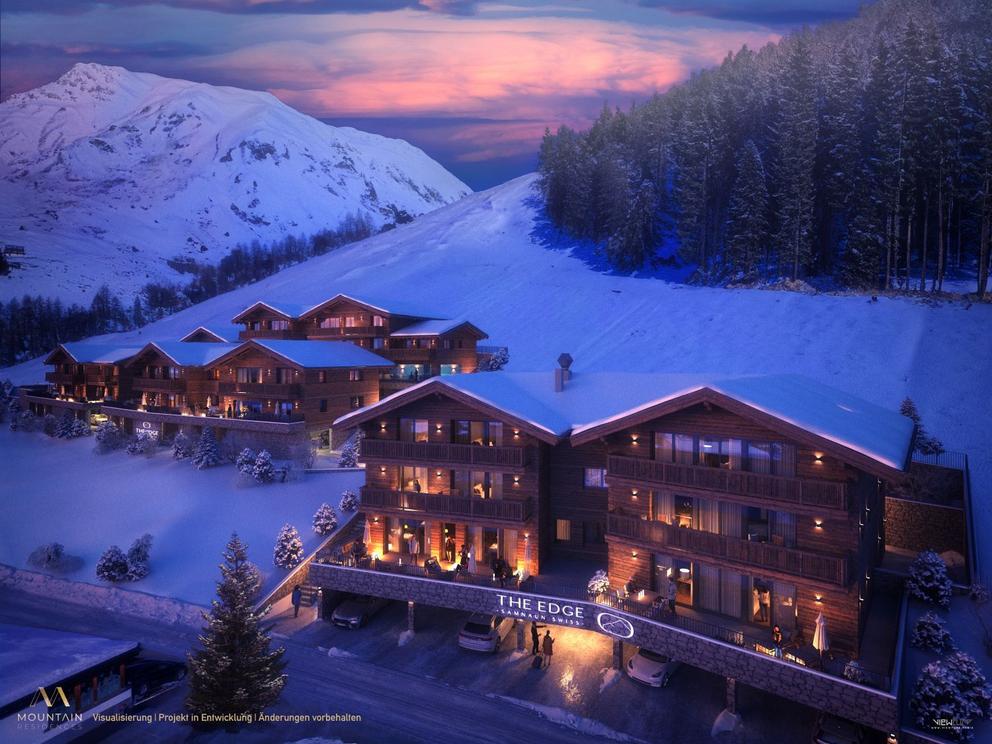
The Edge 1734
- 1-3 beds
- 3 baths
- CHF 865,377 - CHF 2,256,307
The Edge 1.734 is an exclusive ski-in luxury apartment development located at 1,734 meters in the picturesque village of Samnaun-Compatsch, Switzerland.
- Ski-in access
- Spa & wellness area with sauna, steam bath, and outdoor pool
- Exclusive dining, bar, and breakfast services
5 more
Samnaun - Ischgl, Switzerland
About this guide
PURE International has more than 20 years of experience in international property, with particular expertise in Alpine destinations. This guide combines that experience with publicly available Swiss legal and property information.
Sources: BewG and BewV on fedlex.admin.ch, the Federal Office of Justice, the Federal Council on the imputed rental value and the Federal Tax Administration.
Information reviewed for October 2026. This guide is for general information and does not constitute legal or tax advice. Rules vary by canton, municipality, buyer status and property. Obtain independent professional advice before purchasing.
Related guides
- Buyer’s guide
Buying property in Italy as a foreigner: the complete guide
Who can buy, second-home rules in South Tyrol, purchase taxes, mortgages and renting out: what foreign buyers need to know before buying a holiday home in Italy.
 Paul Kleinekorte
- Buyer’s guide
Buying property in Austria as a foreigner: the holiday home guide
Who may buy, second-home status, purchase costs, mortgages and new-builds: what foreign buyers need to know before buying a holiday home in Austria.
Paul Kleinekorte